PTP Checker
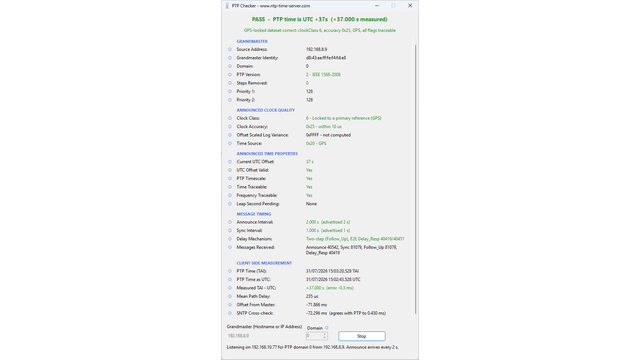
The Galleon Systems PTP checker tests the accuracy of your PTP grandmaster clock.
This free, downloadable software listens to an IEEE 1588 (Precision Time Protocol) grandmaster. Enter the hostname or IP address of your grandmaster and the PTP domain you want to check, and the tool joins the timing exchange as a client.
The tool generates a complete report on your grandmaster, including the announced clock class, clock accuracy and time source, the announced time properties, the message timing, and the measured offset and path delay from the client's point of view.
Each reading is cross-checked against an independent SNTP query, so you can confirm that the PTP timescale really is running at the correct offset from UTC.
Grandmaster:
- Source Address: The IP address the Announce messages are actually arriving from.
- Grandmaster Identity: The eight byte clock identity of the grandmaster, usually derived from its MAC address.
- Domain: The PTP domain number, from 0 to 255. Each domain is an independent timing system on the same network.
- PTP Version: The version of the protocol in use. Version 2 is IEEE 1588-2008.
- Steps Removed: The number of boundary clocks between the client and the grandmaster. Zero means the grandmaster is being heard directly.
- Priority 1: The first tie-breaker used by the best master clock algorithm, from 0 to 255. Lower values win. The default is 128.
- Priority 2: The final tie-breaker used by the best master clock algorithm, from 0 to 255. Lower values win. The default is 128.
Announced Clock Quality:
- Clock Class: How the grandmaster is currently traceable to a reference.
- 6: Locked to a primary reference such as GPS.
- 7: In holdover, having previously been locked to a primary reference.
- 13: Locked to an application specific reference.
- 14: In holdover, having previously been locked to an application specific reference.
- 52 and 58: In holdover and out of specification.
- 248: Default. The clock is free running and not traceable to any reference.
- 255: Slave only.
- Clock Accuracy: The grandmaster's own estimate of how close it is to its reference.
- 0x20: Within 25 ns.
- 0x21: Within 100 ns.
- 0x22: Within 250 ns.
- 0x23: Within 1 us.
- 0x24: Within 2.5 us.
- 0x25: Within 10 us.
- 0x26: Within 25 us.
- 0x27: Within 100 us.
- 0x28: Within 250 us.
- 0x29: Within 1 ms.
- 0x2A: Within 2.5 ms.
- 0x2B: Within 10 ms.
- 0xFE: Unknown.
- Offset Scaled Log Variance: A measure of the stability of the grandmaster's clock. A value of 0xFFFF means the grandmaster does not compute it.
- Time Source: The kind of reference the grandmaster is using.
- 0x10: Atomic clock.
- 0x20: GPS or other GNSS.
- 0x30: Terrestrial radio.
- 0x40: PTP.
- 0x50: NTP.
- 0x60: Hand set.
- 0x90: Other.
- 0xA0: Internal oscillator.
Announced Time Properties:
- Current UTC Offset: The number of seconds that TAI is ahead of UTC. This is 37 seconds at the time of writing.
- UTC Offset Valid: Whether the grandmaster is asserting that the UTC offset it is announcing is correct.
- PTP Timescale: Whether the grandmaster is distributing the PTP timescale, which is TAI, rather than an arbitrary local timescale.
- Time Traceable: Whether the time being distributed is traceable to a primary reference.
- Frequency Traceable: Whether the frequency being distributed is traceable to a primary reference.
- Leap Second Pending: Whether a leap second is announced for the end of the current day, and in which direction. The last minute of the day will have either 61 or 59 seconds.
Message Timing:
- Announce Interval: The measured interval between Announce messages, shown alongside the interval the grandmaster advertises. The default is 2 seconds.
- Sync Interval: The measured interval between Sync messages, shown alongside the interval the grandmaster advertises. The default is 1 second.
- Delay Mechanism: Whether the grandmaster is one-step or two-step, and whether path delay is being measured end to end or peer to peer.
- One-step: The Sync message carries its own transmission timestamp.
- Two-step: The transmission timestamp follows in a separate Follow_Up message.
- E2E: Path delay is measured to the grandmaster using Delay_Req and Delay_Resp.
- P2P: Path delay is measured link by link using Pdelay_Req and Pdelay_Resp.
- Messages Received: A running count of each message type received during the test, which will show any gaps or loss in the timing exchange.
Client-Side Measurement:
- PTP Time (TAI): The time recovered from the grandmaster, on the PTP timescale.
- PTP Time as UTC: The same time converted to UTC using the announced UTC offset.
- Measured TAI - UTC: The offset between the two timescales as actually measured, with the error against the announced value. This will show up a grandmaster that is announcing the wrong UTC offset.
- Mean Path Delay: The average one-way network delay between the grandmaster and the client, calculated from the Sync and Delay_Resp exchange.
- Offset From Master: The offset of the local clock relative to the grandmaster, with the mean path delay removed.
- SNTP Cross-check: An independent SNTP measurement of the same host, and how closely it agrees with the PTP result. A large disagreement points to a problem with the grandmaster rather than with the network.
NTP Check
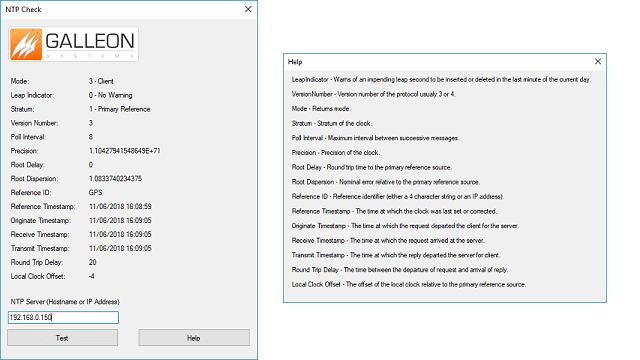
Acts as a client to your NTP server. Sends time requests and provides a full report on the precision of your time server. Download for free.
NTP Time Zone Clock
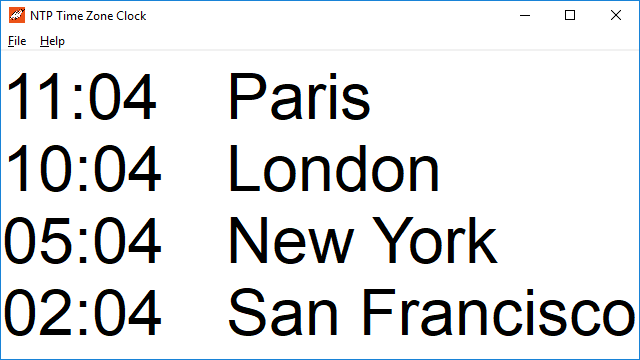
Displays the local time of over 300 cities worldwide. Ideal for organisations with international staff and customers. Download for free.
NTP Server Tool
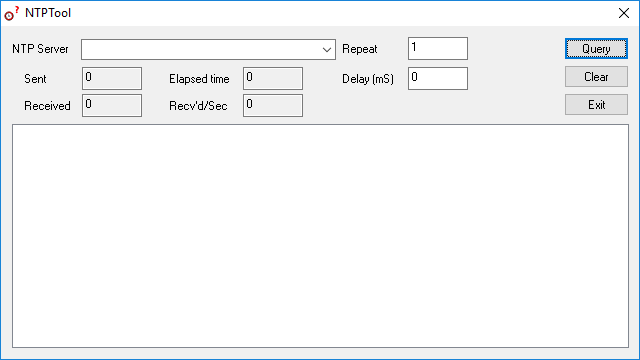
Free, downloadable tool acts as a client to your NTP server to test its accuracy.